Waterproof Speakers: Ingress Protection
Decoding IP67/IPX7 ratings, examining hydrophobic acoustic meshes, and evaluating buoyancy design.
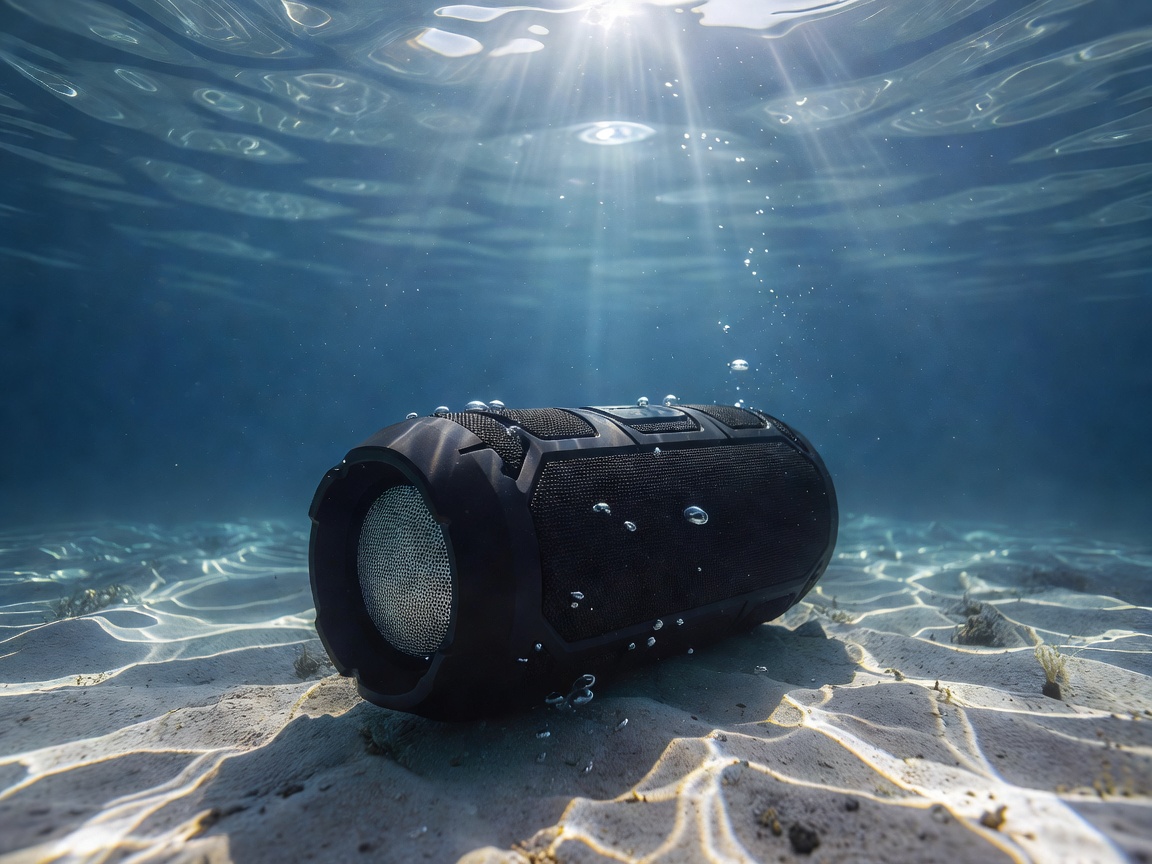
Designing a speaker that operates submerged in water presents a paradoxical engineering challenge. Sound is generated by moving air, requiring an open pathway from the internal driver to the external environment. Yet, waterproof electronics demand hermetic sealing. Reconciling these two opposing requirements involves advanced materials science and meticulous manufacturing tolerances.
Decoding IP Ratings
The International Electrotechnical Commission (IEC) standard 60529 defines Ingress Protection (IP) ratings. For speakers, you will typically see ratings like IPX7 or IP67. The two digits represent distinct protection categories.
- First Digit (Dust/Particulates): An 'X' means it was not tested for dust ingress. A '6' is the maximum rating, indicating the unit is totally "dust-tight," verified in a vacuum chamber utilizing talcum powder.
- Second Digit (Liquids): A '7' indicates the speaker can withstand immersion in water up to 1 meter deep for 30 minutes. An '8' indicates continuous immersion beyond 1 meter under conditions specified by the manufacturer. A '6' protects against powerful water jets but not necessarily submersion.
Crucially, an IPX7 rating tests for static submersion in fresh water. It does not guarantee survival against high-velocity impacts (like falling off a moving jet ski) or highly corrosive environments (like saltwater or heavily chlorinated pools), which can degrade rubber gaskets over time.
Hydrophobic Acoustic Membranes
To allow air pressure to escape while keeping water out, waterproof speakers utilize specialized acoustic meshes, often manufactured using expanded polytetrafluoroethylene (ePTFE). This material is highly hydrophobic (water-repelling).
The microscopic pores in the ePTFE membrane are large enough to allow sound waves to pass through with minimal high-frequency attenuation, but small enough that the surface tension of water prevents liquid droplets from penetrating the barrier. Over time, however, if this membrane becomes clogged with fine sand, salt crystals, or sunscreen, the acoustic output will become severely muffled until properly rinsed with fresh water.
Conformal Coating and Internal Potting
Engineers do not rely solely on the external casing. Inside a premium waterproof speaker, the Printed Circuit Board (PCB) undergoes a process called conformal coating. A thin polymeric film is applied directly to the circuitry, acting as a secondary line of defense against condensation that might form inside the chassis during rapid temperature changes (e.g., leaving a speaker in the hot sun and then throwing it into cold water).
In highly ruggedized units, critical components may be "potted"—completely encased in a solid block of epoxy or silicone compound, rendering them entirely impervious to water, shock, and vibration.
Buoyancy Engineering
An IPX7 rating is useless if a speaker sinks to the bottom of a lake beyond the 1-meter pressure threshold, crushing the internal gaskets. Consequently, true amphibious speakers are engineered for positive buoyancy. This requires balancing the heavy components—the neodymium magnets and the lithium-ion battery—against precisely calculated internal air volumes or lightweight closed-cell foam inserts.
Designing a speaker to float *correctly* is equally important. It must self-right in the water so that the primary acoustic drivers point upward rather than downward into the water column, ensuring the music remains audible.
Port Sealing and Maintenance
The most common point of failure for waterproof speakers is the charging port. While modern capless USB-C ports can be internally waterproofed, they must be completely bone-dry before connecting a charging cable to prevent electrolytic corrosion of the pins. Older designs rely on thick rubber flaps; if this flap is improperly seated or accumulates debris, the IP rating drops to zero instantaneously.