Party Speakers: High SPL & Bass Extension
Deep dive into massive sound pressure levels (SPL), dynamic DSP for bass enhancement, and PA-style connectivity.
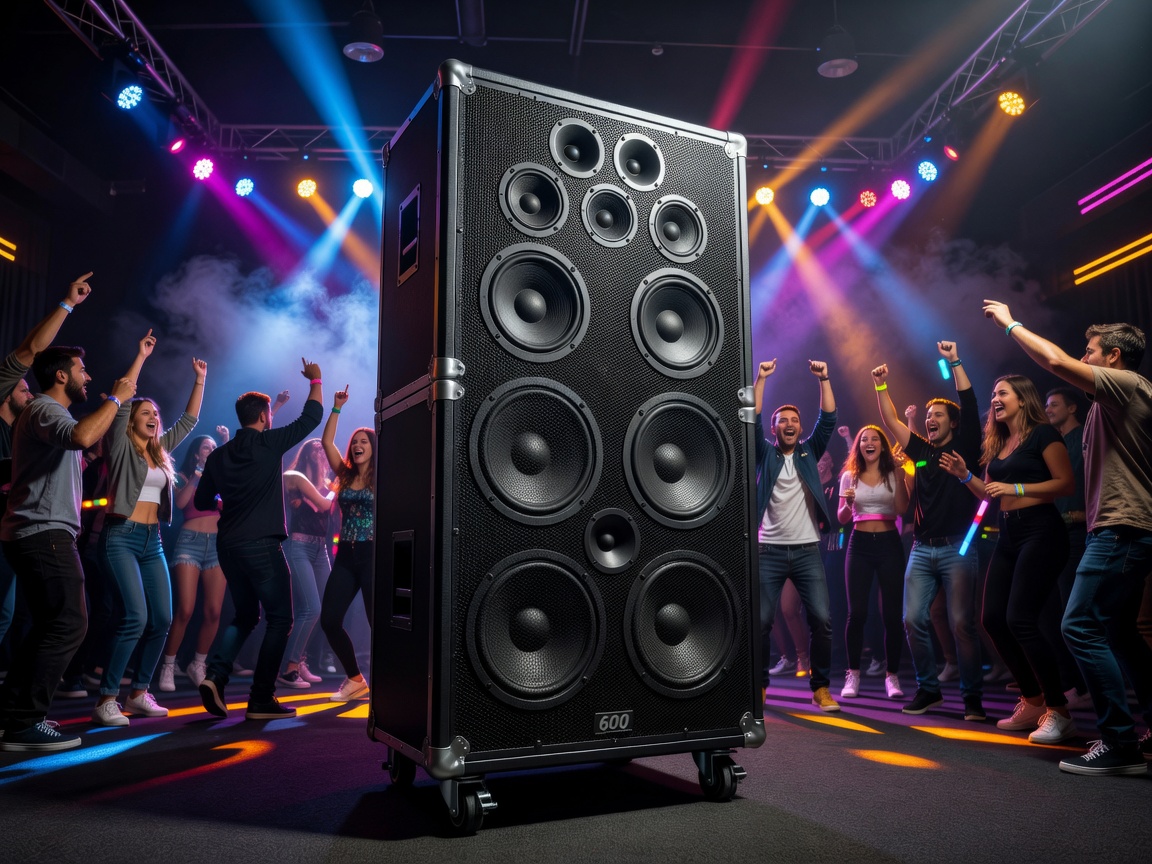
While portable speakers prioritize convenience, party speakers prioritize sheer acoustic trauma. Designing a speaker capable of providing adequate Sound Pressure Level (SPL) for an outdoor gathering of fifty people requires abandoning miniature drivers in favor of PA (Public Address) system architectures scaled down for consumer use.
Understanding SPL and Driver Displacement
The primary metric of a party speaker is not its wattage, but its maximum SPL, measured in decibels (dB). A 3dB increase in SPL requires a doubling of amplifier power. To achieve the 100dB+ output required to overcome crowd noise and outdoor open-air dissipation, party speakers utilize large, high-excursion woofers—typically between 6.5 and 12 inches in diameter.
These drivers move significant volumes of air (displacement). Unlike compact speakers that use sealed enclosures with passive radiators, party speakers frequently employ bass-reflex (ported) enclosures. The ports are tuned to a specific resonance frequency (often between 35Hz and 45Hz) to reinforce the low-end output, trading a flat frequency response for maximum kinetic impact in the sub-bass regions.
Digital Signal Processing (DSP) and Dynamic EQ
To prevent these massive drivers from destroying themselves at high volumes, advanced DSP is mandatory. As the volume approaches maximum, the DSP engages dynamic compression. This prevents clipping (a form of square-wave distortion that rapidly burns out voice coils) by automatically attenuating the bass frequencies.
- Fletcher-Munson Compensation: Human hearing is less sensitive to bass at lower volumes. Many party speakers apply an inverse EQ curve at low volumes, boosting the bass and treble (often branded as "Bass Boost" or similar proprietary terms).
- Thermal Management: Extended play at high volumes generates immense heat in the amplifier circuitry and voice coils. DSP monitoring reduces output limits dynamically as temperatures rise, ensuring continuous playback without catastrophic failure.
Power Infrastructure: AC vs. DC
Party speakers blur the line between portable and stationary. While many feature internal Lead-Acid or massive Lithium-ion battery banks, true high-SPL output is often restricted when running on DC battery power.
For example, a speaker advertised as "800 Watts" may only produce that output when plugged directly into a 120V/240V AC wall outlet. When running on its internal battery, the voltage limitations restrict the amplifier's headroom, capping the output at a fraction of its wired capability. Buyers must read the specifications carefully to understand the difference between AC-powered SPL and battery-powered SPL.
Connectivity and Array Capabilities
Modern party speakers incorporate connectivity features previously reserved for professional DJ equipment. Beyond standard Bluetooth, they often feature:
- TWS (True Wireless Stereo): Allowing two identical speakers to pair seamlessly, designating one as the left channel and one as the right channel. This completely alters the soundstage, providing proper stereo separation that a single cabinet cannot achieve.
- Daisy Chaining: Physical TRS or RCA outputs to link dozens of speakers together with zero latency, critical for large spaces where Bluetooth mesh protocols would introduce echo.
- Microphone and Instrument Inputs: High-impedance (Hi-Z) 1/4-inch inputs allow the speaker to double as a guitar amplifier or karaoke PA system, complete with independent gain staging and onboard reverb effects.
Evaluating Form Factor
A speaker weighing 40-80 lbs requires ergonomic consideration. Look for robust, integrated telescoping handles and large, rubberized wheels. A poorly designed wheel chassis on a heavy speaker becomes a significant liability during transport over gravel or grass.