Portable Speakers: Power to Weight Optimization
Analyzing the delicate balance between acoustic output, battery density, and structural durability in compact form factors.
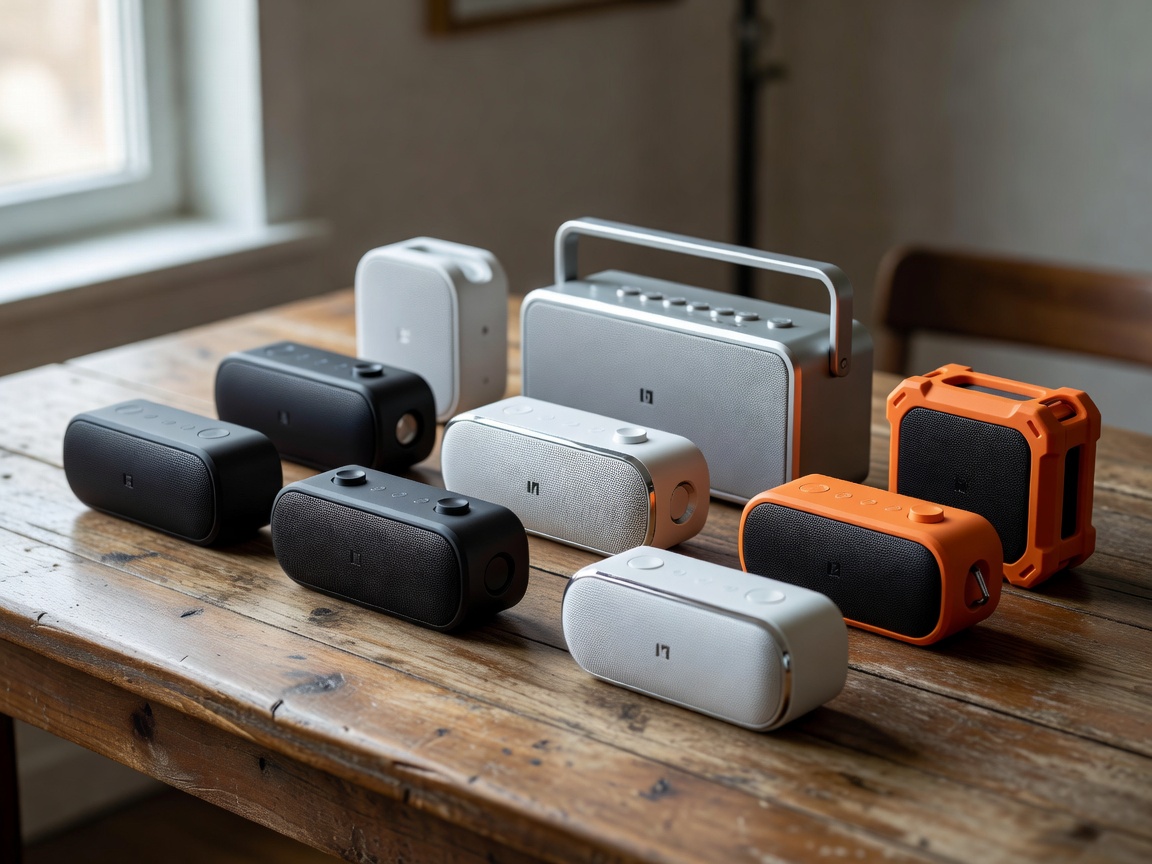
The engineering challenge of the portable Bluetooth speaker is fundamentally one of physics: producing low-frequency sound waves requires moving large volumes of air, a task traditionally demanding large drivers and heavy enclosures. Modern portable audio equipment bridges this gap through a combination of acoustic trickery, advanced materials, and digital signal processing (DSP).
Acoustic Design in Constrained Volumes
To generate bass in a chassis measuring only a few inches across, engineers almost universally rely on passive radiators. Unlike a traditional ported bass reflex design, which requires cabinet depth to avoid "port chuffing" (air turbulence noise), a passive radiator uses a weighted speaker cone without a voice coil. It is driven pneumatically by the air pressure created inside the sealed cabinet by the active drivers.
This allows a portable speaker to achieve a much lower frequency response—often dipping into the 50Hz to 60Hz range—than would otherwise be mathematically possible for a sealed box of its internal volume. When assessing a portable speaker's acoustic potential, looking at the surface area of its passive radiators is just as critical as examining its primary transducers.
Battery Chemistry and Power Delivery
The transition from older battery technologies to high-density Lithium-ion (Li-ion) and Lithium-polymer (LiPo) cells has drastically changed the power-to-weight ratio of portable audio.
- Capacity vs. Draw: A typical compact speaker houses between 2,500mAh and 5,000mAh. However, the amplifier's efficiency (most use Class-D amplifiers due to their ~90% electrical efficiency) dictates how long this lasts.
- Volume Non-linearity: Battery life claims (e.g., "up to 24 hours") are virtually always tested at 50% volume. Because audio power operates on a logarithmic scale, playing a speaker at 100% volume requires significantly more than double the power of 50%. A 24-hour battery can drain in 4 hours at maximum output.
- USB-C Power Delivery: Modern standards dictate USB-C for charging. Advanced units utilize USB-PD (Power Delivery), allowing for rapid charging protocols and, crucially, allowing the speaker to act as a power bank with variable voltage output to charge smartphones.
Connectivity Protocols
The Bluetooth specification has seen rapid iteration, significantly impacting portable speakers. Bluetooth 5.0 introduced double the data speed and quadruple the range of 4.2, largely solving drop-out issues in outdoor environments. Current standards (Bluetooth 5.3) optimize low-energy states, slightly improving battery life when idling.
Multipoint connectivity—the ability to maintain simultaneous connections to two source devices—is an increasingly demanded feature. This requires specific Bluetooth chipsets (often manufactured by Qualcomm or MediaTek) capable of managing two MAC address handshakes without dropping packets, allowing seamless switching between a laptop and a smartphone.
Structural Integrity and Portability
Weight is the enemy of portability but the ally of audio quality. A heavier speaker enclosure resists resonance (unwanted vibration of the plastic chassis that colors the sound). Engineers use glass-fiber reinforced plastics and silicone dampening to create acoustically inert cabinets without adding the mass of traditional MDF (Medium Density Fiberboard).
The form factor also dictates dispersion. Cylindrical speakers use 360-degree driver placement, bouncing high frequencies off acoustic deflectors to create an omnidirectional soundstage. This is ideal for placing in the center of a group, whereas directional, front-firing portable speakers provide better stereo imaging but must be aimed directly at the listener.
Key Takeaways for Buyers
When selecting a portable speaker, disregard arbitrary "wattage" claims, which are often cited as Peak Music Power Output (PMPO) rather than Root Mean Square (RMS) continuous power. Instead, evaluate the physical volume of the speaker, the presence of passive radiators, and ensure it utilizes at least Bluetooth 5.0 for connection stability. Check the battery capacity relative to its Class-D amplifier draw if you intend to use it primarily outdoors at high volumes.